
If your child is turning 4 or 5, you are probably asking yourself: Should they start pre-K or go straight to kindergarten? It is one of the biggest decisions Phoenix parents face, and the answer is not always obvious.
As the founder of two Montessori schools in Phoenix, I have guided hundreds of families through this exact decision. Here is what I wish every parent knew.
What Is Pre-K?
Pre-kindergarten (pre-K) is an early childhood program designed for children typically ages 3 to 5. The focus is on building the foundation skills children need before formal schooling begins:
- Social skills — sharing, taking turns, resolving conflicts
- Emotional regulation — identifying feelings, self-calming strategies
- Fine motor development — holding a pencil, cutting with scissors, manipulating small objects
- Early literacy — letter recognition, phonemic awareness, storytelling
- Numeracy basics — counting, sorting, patterns
In Arizona, pre-K is not publicly funded statewide. Most pre-K options are private, though Arizona’s Empowerment Scholarship Account (ESA) program can help cover tuition at approved schools.
What Is Kindergarten?
Kindergarten marks the beginning of formal education. In Arizona, children must turn 5 by September 1 to enroll. The curriculum shifts toward structured academics:
- Reading — decoding words, sight words, reading simple sentences
- Writing — forming letters, spelling, writing complete sentences
- Mathematics — addition, subtraction, number sense to 100
- Science and social studies — introductory concepts
- Standardized expectations — following classroom routines, sitting for longer periods
Arizona does not require kindergarten attendance — compulsory education begins at age 6. However, children who skip kindergarten often struggle to catch up in first grade.
Pre-K vs Kindergarten: Key Differences
Age: Pre-K is for ages 3 to 5. Kindergarten is for ages 5 to 6.
Focus: Pre-K emphasizes school readiness and social-emotional growth. Kindergarten focuses on formal academics.
Structure: Pre-K is play-based and flexible. Kindergarten is teacher-led and structured.
Cost in Arizona: Pre-K is typically private (ESA eligible). Kindergarten can be free (public) or private.
Required? Neither is mandatory in Arizona. Compulsory education starts at age 6.
Class size: Pre-K classes are typically 10 to 15 students. Kindergarten classes often have 20 to 25 or more.
Signs Your Child Is Ready for Kindergarten
Age alone does not determine readiness. Here are the indicators educators look for:
- Can follow multi-step directions — Put your backpack away, then sit at your desk
- Manages emotions independently — Handles frustration without meltdowns
- Separates from parents comfortably — No extended distress at drop-off
- Shows interest in learning — Asks questions, wants to read, counts spontaneously
- Has basic self-care skills — Uses the bathroom, opens lunch containers, zips a jacket
- Can focus for 10 to 15 minutes — Stays engaged with an activity or story
If your child is not showing most of these signs, an extra year of pre-K can make a significant difference.
Why Montessori Blurs the Line (In a Good Way)
Here is what most comparison guides will not tell you: in a Montessori classroom, the pre-K vs kindergarten distinction barely exists.
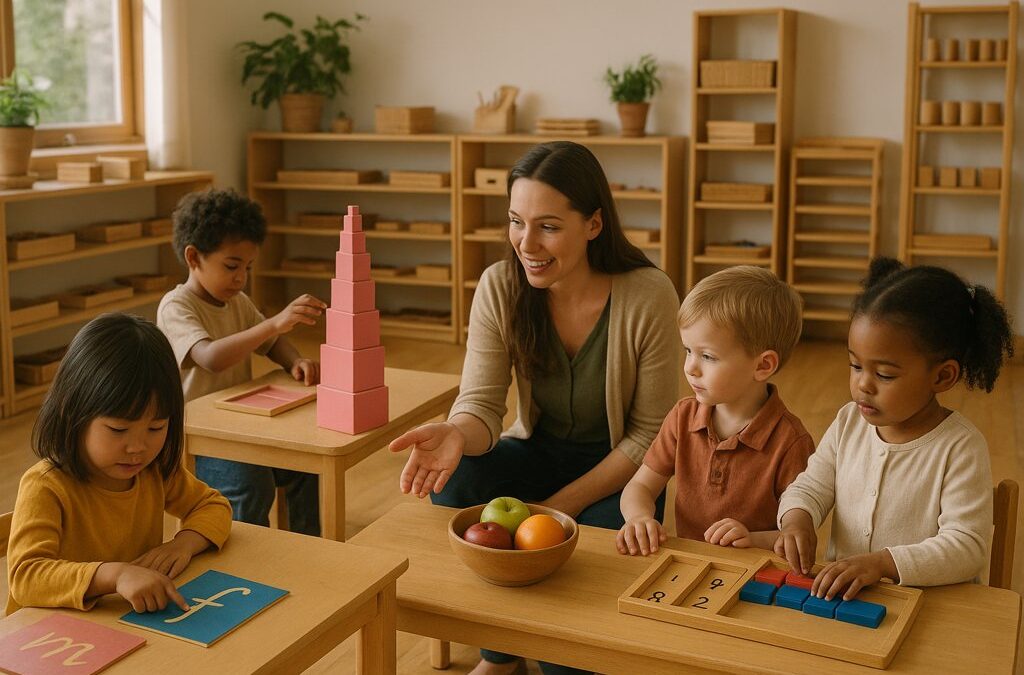
Montessori uses mixed-age classrooms (typically ages 3 to 6) where children progress at their own pace. A 4-year-old who is ready for reading does not have to wait for kindergarten. A 5-year-old who needs more time with social skills is not pushed into academics too fast.
At Amici Trilingual Montessori in Ahwatukee, our primary classroom serves children from age 3 through kindergarten in one environment. Children learn from older peers and younger classmates simultaneously — building leadership, empathy, and academic skills organically.
The added advantage? Our students learn in three languages — English, Spanish, and Mandarin — during these critical years when language acquisition is effortless.
What About Arizona ESA Program?
Arizona Empowerment Scholarship Account provides approximately 7,000 dollars per year for approved educational expenses, including private school tuition. This applies to both pre-K and kindergarten at qualifying schools.
Both Amici Trilingual Montessori and Beibei Amigos Language Preschool accept ESA funds, making high-quality Montessori education accessible to more Arizona families.
Questions Phoenix Parents Ask Us
Should my child do two years of pre-K?
Often yes, especially if they have a summer birthday. Two years of pre-K gives children time to develop confidence, social skills, and early academics without the pressure of formal kindergarten expectations. In our Montessori program, these children often enter kindergarten reading above grade level.
Can my child skip pre-K and go straight to kindergarten?
Legally, yes — Arizona does not require pre-K. However, children who attend quality pre-K programs are more likely to read at grade level by third grade and show stronger problem-solving skills through elementary school. We strongly recommend at least one year of pre-K.
What if my child turns 5 after September 1?
They will need to wait until the following year for public kindergarten. Private schools like Amici have more flexibility with enrollment dates — schedule a tour to discuss your child’s specific situation.
Is Montessori kindergarten different from public kindergarten?
Yes. Montessori kindergarten emphasizes self-directed learning, hands-on materials, and individual pacing rather than whole-group instruction. Children work with concrete math materials (like bead chains for multiplication) and moveable alphabets for writing — making abstract concepts tangible.
The Bottom Line
There is no universal right answer — it depends on your child’s development, your family’s goals, and the programs available to you. But here is what 17 years of running schools has taught me:
The best investment you can make is giving your child a strong foundation. Whether that is one year of pre-K, two years, or starting kindergarten — the quality of the program matters more than the label.
If you are weighing options for your family, we would love to help. Schedule a tour at Amici Trilingual Montessori and see our mixed-age classrooms in action. Your child’s teacher will be happy to discuss readiness with you one-on-one.
Sean Diana is the founder of Amici Trilingual Montessori in Ahwatukee and Beibei Amigos Language Preschool in Phoenix. With a Master’s in Educational Administration and 17+ years of experience in early childhood education, he has helped hundreds of families navigate the pre-K to kindergarten transition.