The Complete Kindergarten Readiness Checklist for 2026: Is Your Child Prepared?
As a parent in Phoenix, you’re probably wondering: “Is my child really ready for kindergarten?” After more than 20 years in early childhood education—including serving as a school principal and head of faculty internationally—I’ve watched thousands of children make this important transition. The good news? With the right preparation, every child can enter kindergarten feeling confident and excited to learn.
This comprehensive kindergarten readiness checklist will help you assess your child’s development across all key areas and identify any skills that might need extra attention before the big day arrives.
Quick-Reference Printable Kindergarten Readiness Checklist
Here’s your at-a-glance checklist to assess kindergarten readiness. Save or print this section for easy reference:
Academic Skills
- Recognizes and names most letters of the alphabet
- Identifies letter sounds (phonemic awareness)
- Counts to 20 or higher
- Recognizes numbers 1-10
- Understands one-to-one correspondence (counting objects)
- Identifies basic shapes (circle, square, triangle, rectangle)
- Recognizes and names primary colors
- Can write their first name
- Holds a pencil with proper grip
- Shows interest in books and stories
Social-Emotional Skills
- Separates from parents without excessive distress
- Takes turns and shares with peers
- Follows simple two or three-step instructions
- Works independently on tasks for 10-15 minutes
- Expresses needs and feelings with words
- Shows respect for others’ belongings
- Transitions between activities without major meltdowns
- Demonstrates self-control and impulse management
- Shows empathy toward others
- Participates in group activities
Physical Development
- Uses scissors to cut along a line
- Holds and uses a pencil, crayon, or marker
- Builds with blocks and manipulatives
- Completes simple puzzles (12-20 pieces)
- Buttons, zips, and manages clothing independently
- Runs, jumps, and climbs confidently
- Catches and throws a ball
- Balances on one foot
- Uses the bathroom independently
- Washes hands without reminders
Language & Communication
- Speaks in complete sentences (5-6 words)
- Tells simple stories with a beginning, middle, and end
- Asks and answers questions
- Follows verbal directions
- Identifies rhyming words
- Recognizes their name in print
- Listens to stories for 10-15 minutes
- Communicates needs clearly to adults and peers
Understanding Kindergarten Readiness: What It Really Means
Kindergarten readiness isn’t about your child being a perfect reader or mathematician before day one. Rather, it’s about having the foundational skills and emotional maturity to thrive in a structured learning environment. Research from the National Education Association shows that children who enter kindergarten with strong social-emotional skills and basic academic foundations adjust more quickly and develop a lifelong love of learning.
In Phoenix-area schools, kindergarten expectations have evolved. Today’s kindergarteners are expected to know more than previous generations, which makes quality preschool preparation more important than ever. However, kindergarten readiness is about the whole child—not just academics.
The Four Pillars of Kindergarten Readiness
1. Academic Readiness: Building a Foundation for Learning
Academic readiness encompasses the pre-literacy and pre-math skills that prepare children for formal instruction. Your child doesn’t need to read chapter books or solve complex equations, but they should have exposure to foundational concepts.
Literacy Foundations: By kindergarten entry, most children should recognize many letters and understand that letters represent sounds. They should show interest in books, understand that we read from left to right, and be able to identify their own name in print. Many children will also recognize familiar words like “stop” or “exit.”
Math Readiness: Number sense is crucial. Children should count objects accurately up to 10 or 20, understand concepts like “more” and “less,” and recognize written numerals. They should also identify basic shapes and understand simple patterns (red-blue-red-blue).
Fine Motor Skills for Writing: The ability to hold a pencil with a proper grip and control it to make marks on paper is essential. Your child should be able to write their first name, even if the letters aren’t perfectly formed. Drawing shapes, tracing lines, and cutting with scissors all build these important skills.
2. Social-Emotional Readiness: The Heart of School Success
In my years as a principal, I observed that children with strong social-emotional skills consistently outperformed their peers—even when they started with lower academic skills. Kindergarten is a social environment, and success requires emotional regulation, cooperation, and independence.
Separation and Independence: Your child should be able to separate from you without prolonged distress. They should handle their own bathroom needs, manage their belongings, and complete simple self-care tasks like washing hands and opening lunch containers.
Following Instructions: Kindergarten teachers give frequent directions to groups of 20+ children. Your child needs to listen, process, and follow two- or three-step instructions independently. For example: “Put your backpack in your cubby, wash your hands, and sit on the carpet.”
Social Skills: Taking turns, sharing materials, and resolving minor conflicts with words (not aggression) are essential. Children who struggle with sharing or who resort to hitting or biting will have difficulty adjusting to the classroom environment.
Emotional Regulation: Kindergarten involves transitions, waiting, and sometimes disappointment (not being line leader, not getting the red crayon). Children need basic strategies to manage frustration, express feelings with words, and recover from upsets relatively quickly.
3. Physical Readiness: Large and Small Motor Skills
Physical development often gets overlooked in discussions of kindergarten readiness, but it’s crucial for classroom success.
Fine Motor Skills: Beyond pencil grip, children need hand strength and coordination to manipulate small objects. Building with LEGO, stringing beads, using playdough, and working with puzzles all develop the hand muscles and dexterity needed for writing, cutting, and classroom tasks.
Gross Motor Skills: Running, jumping, climbing, and balancing aren’t just for recess—they’re indicators of overall physical development and body awareness. Children who struggle with large motor skills may also have difficulty with spatial awareness and may be more prone to accidents in crowded classrooms.
Self-Care: Buttoning, zipping, tying shoes (or managing velcro), putting on jackets, and opening lunch containers independently are practical skills that reduce stress and increase confidence throughout the school day.
4. Language Readiness: Communication is Key
Language skills underpin all learning. Children need robust vocabulary, clear articulation, and the ability to express their thoughts to succeed in kindergarten.
Expressive Language: Your child should speak in complete sentences, tell simple stories about their experiences, and ask questions to learn more. They should be able to explain what they need or want without resorting to gestures or crying.
Receptive Language: Understanding what others say is equally important. Children should comprehend multi-step directions, understand prepositions (under, beside, between), and grasp basic concepts like “first” and “last.”
Conversation Skills: Back-and-forth dialogue, staying on topic, and listening while others speak are all important for classroom discussions and building friendships.
Preschool Readiness vs Kindergarten Readiness: What’s the Difference?
Parents often ask: “Is pre-k the same as kindergarten?” The short answer is no—and understanding the distinction helps you support your child’s development at each stage.
Preschool Readiness (typically ages 2.5-4) focuses on foundational social skills and basic independence. A preschool-ready child can:
- Separate from parents for short periods
- Communicate basic needs
- Use the toilet (or be actively training)
- Engage in parallel play alongside peers
- Follow simple one-step directions
- Hold a crayon and scribble
- Sit for a short story (5-7 minutes)
Kindergarten Readiness (typically age 5) requires more advanced skills across all domains. The expectations are higher:
- Complete independence with self-care and bathroom
- Cooperative play and friendship-building
- Following multi-step instructions in a group setting
- Sustained attention for 15-20 minutes
- Pre-literacy skills (letter recognition, phonemic awareness)
- Pre-math concepts (counting, number recognition, shapes)
- Problem-solving and conflict resolution with words
- Emotional regulation in various situations
The preschool years (pre-k, transitional kindergarten, or pre-kindergarten programs) serve as a bridge, gradually building the skills children need for kindergarten success. Quality pre-kindergarten programs in Ahwatukee like those at Amici provide intentional skill-building in all readiness areas.
Kindergarten Readiness Activities: Building Skills at Home
You don’t need expensive workbooks or tutors to prepare your child for kindergarten. Simple, everyday activities build essential skills naturally:
For Academic Skills:
- Read together daily and ask questions about the story
- Point out letters and numbers in the environment (street signs, store names)
- Count everything—stairs, snacks, toys during cleanup
- Practice writing their name with crayons, chalk, or in sand
- Play rhyming games and sing alphabet songs
- Sort objects by color, size, or shape
- Build with blocks and create patterns
For Social-Emotional Skills:
- Arrange playdates where children must share and take turns
- Give two- and three-step directions and expect follow-through
- Name feelings throughout the day (“You look frustrated. Let’s take a deep breath.”)
- Practice transitions (“In five minutes, we’ll clean up and have snack”)
- Assign simple chores that build responsibility
- Role-play common scenarios (asking to join a game, resolving conflicts)
For Physical Skills:
- Provide scissors and cutting practice with paper
- Offer playdough, clay, or putty for hand strengthening
- Do puzzles together, gradually increasing difficulty
- Practice buttoning, zipping, and snapping on clothing or busy boards
- Visit playgrounds for climbing, swinging, and balancing
- Play catch, kick balls, and do simple obstacle courses
For Language Skills:
- Have real conversations—ask open-ended questions
- Expand their vocabulary by naming things you see
- Encourage storytelling about their day
- Sing songs, recite nursery rhymes, and play word games
- Limit screen time and maximize conversation time
How Montessori Prepares Children for Kindergarten
At Amici Montessori, we’ve watched hundreds of children transition seamlessly into kindergarten and beyond, often exceeding their peers in multiple areas. The Montessori approach naturally addresses all four pillars of kindergarten readiness in ways that honor each child’s developmental timeline.
Multi-Age Classrooms Build Leadership and Empathy
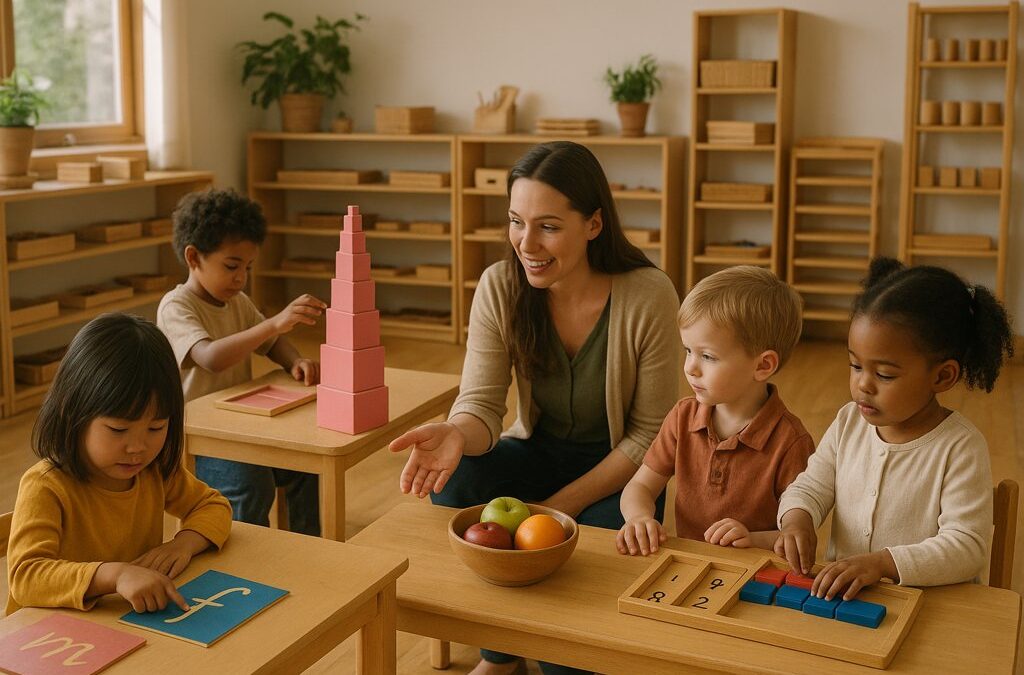
Our mixed-age classrooms (typically spanning three years) mirror real-world social structures. Younger children observe and learn from older peers, while older children reinforce their knowledge by teaching and modeling. This builds empathy, patience, and leadership—all critical social-emotional skills for kindergarten.
By the time a Montessori child enters kindergarten, they’ve spent years in a community where they learned to wait, share, help others, and advocate for themselves respectfully.
Practical Life Skills Foster Independence
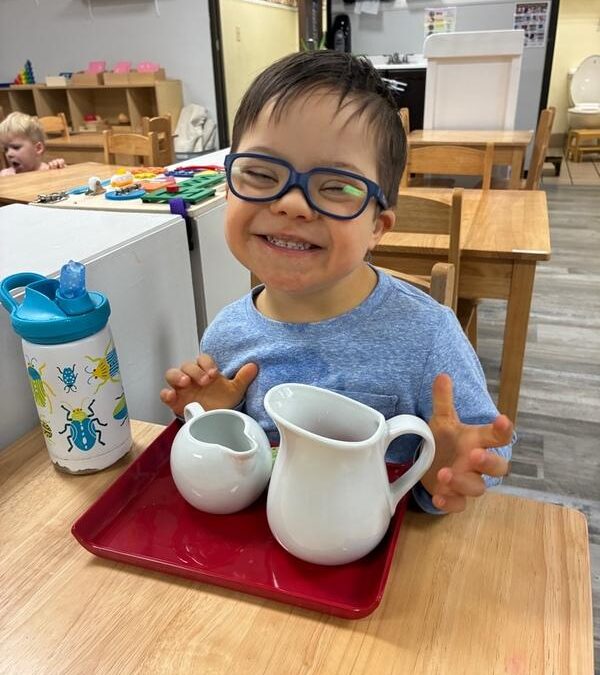
Montessori children pour water, button their own smocks, clean up spills, and help prepare snacks from an early age. These aren’t just chores—they’re intentional exercises that build fine motor skills, sequential thinking, and self-sufficiency.
When a Montessori child enters kindergarten, managing zippers, opening lunch containers, and tidying their workspace are second nature. This independence allows them to focus on learning rather than logistics.
Self-Directed Learning Creates Confident Learners
In Montessori classrooms, children choose their work from among prepared options. They learn to start tasks, persist through challenges, and complete work independently. Teachers observe and guide rather than direct every moment.
This cultivates intrinsic motivation, problem-solving skills, and the ability to work independently—all essential for kindergarten, where teachers can’t provide constant one-on-one attention.
Concrete Materials Build Deep Understanding
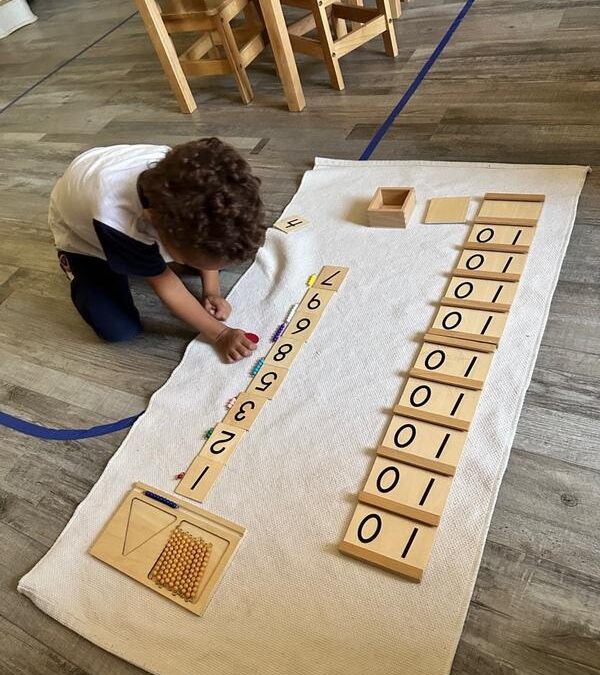
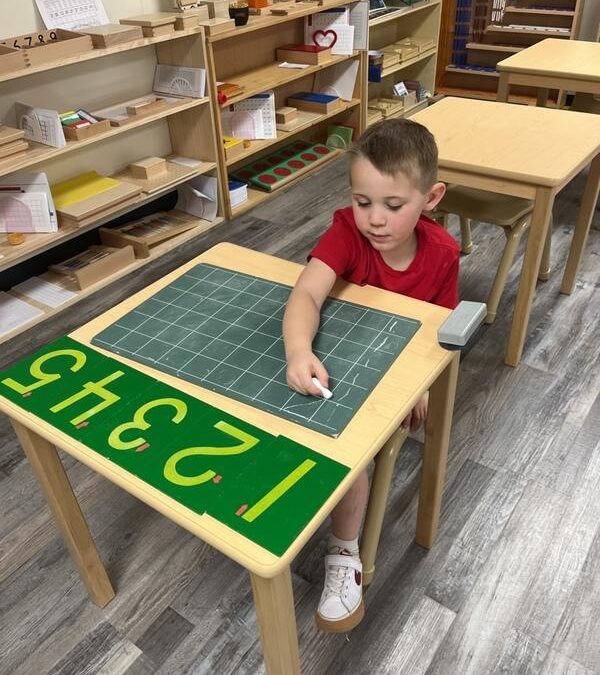
Montessori math and literacy materials are tangible and manipulative. Children physically count beads, trace sandpaper letters, and build words with movable alphabets. This hands-on learning creates neural pathways and conceptual understanding that abstract worksheets can’t match.
Kindergarten teachers consistently tell us that children from Montessori programs have unusually strong number sense and phonemic awareness because they’ve experienced these concepts through multiple senses.
Trilingual Immersion: Amici’s Unique Advantage
At Amici, children learn in Mandarin, Spanish, and English simultaneously through our trilingual immersion program. This isn’t just about language—it’s about cognitive flexibility.
Research from the University of Washington shows that multilingual children demonstrate superior executive function skills, including:
- Enhanced focus and attention control
- Better problem-solving abilities
- Increased mental flexibility
- Stronger memory and recall
These cognitive advantages translate directly to kindergarten readiness. Our trilingual students enter kindergarten with advanced listening skills, cultural awareness, and the confidence that comes from communicating across languages.
Moreover, bilingual and multilingual children have a distinct advantage in Phoenix’s diverse community and in our increasingly global world. They’re not just kindergarten-ready—they’re future-ready.
What is a Kindergarten Assessment?
Many Phoenix-area schools conduct kindergarten assessments or screenings before school starts. Understanding what these assess helps reduce anxiety for both parents and children.
What Kindergarten Assessments Typically Include:
- Letter and Number Recognition: Identifying letters (especially those in their name) and numbers 1-10
- Phonemic Awareness: Recognizing beginning sounds or rhyming words
- Counting: Counting objects and understanding one-to-one correspondence
- Fine Motor Skills: Drawing shapes, writing their name, or using scissors
- Following Directions: Simple tasks that assess listening and comprehension
- Color and Shape Recognition: Identifying basic colors and shapes
- Social-Emotional Observation: How the child separates from parents, interacts with the assessor, and handles new situations
Important to Know: Kindergarten assessments are not pass/fail tests. They help teachers understand each child’s starting point so they can differentiate instruction appropriately. A child who doesn’t know all their letters isn’t “failing”—the teacher simply knows to provide extra support in that area.
If your child attends a quality preschool or pre-k program, they’ll naturally develop these skills through daily activities. There’s no need for flashcards or drilling—in fact, that can create anxiety and reduce a child’s natural love of learning.
Frequently Asked Questions About Kindergarten Readiness
What should my preschooler know before kindergarten?
Focus on four key areas: (1) Social-emotional skills like following directions, sharing, and managing feelings; (2) Basic literacy skills including letter recognition and interest in books; (3) Early math concepts like counting to 20 and recognizing numbers 1-10; and (4) Physical independence including self-care and fine motor skills. Remember, kindergarten is where formal learning begins—your preschooler doesn’t need to read or do complex math yet.
Is pre-k the same as kindergarten?
No. Pre-k (pre-kindergarten) is typically for 4-year-olds and focuses on building school readiness skills through play-based learning. Kindergarten is the first year of formal elementary school, usually for 5-year-olds, with more structured academic instruction. Pre-k serves as a bridge, helping children develop the skills they’ll need to thrive in kindergarten.
At what age should a child be ready for kindergarten?
Most states, including Arizona, require children to be 5 years old by a specific cutoff date (in Arizona, it’s September 1). However, chronological age is just one factor. Some children who turn 5 right before the cutoff may benefit from an additional year of preschool, especially if they’re young for their grade. Consider your child’s social-emotional maturity, attention span, and independence—not just academics—when making this decision.
How do I know if my child is ready for kindergarten?
Use the checklist at the top of this article as a guide. Your child doesn’t need to master every item, but they should demonstrate age-appropriate skills in all four domains: academic, social-emotional, physical, and language. If you have concerns, talk with your child’s preschool teacher—they can provide valuable insight based on daily observations. Trust your parental instinct, too; you know your child best.
What are the most important kindergarten readiness skills?
While all skills matter, research consistently shows that social-emotional skills are the strongest predictors of kindergarten success. Children who can follow directions, manage their emotions, work independently, and get along with peers adapt more quickly and learn more effectively than children with strong academics but weak social skills. Independence—handling bathroom needs, managing belongings, and communicating needs—is also critical for day-to-day success.
Does my child need to read before kindergarten?
No. Kindergarten is where formal reading instruction begins. Your child should have pre-reading skills (letter recognition, phonemic awareness, interest in books), but they don’t need to read independently. In fact, pushing reading too early can backfire, creating anxiety or resistance. Focus instead on reading together daily, singing songs, and playing with language naturally. Children who arrive at kindergarten with a love of books and stories become stronger readers than those who were drilled on sight words.
How does Montessori prepare children for kindergarten?
Montessori education builds kindergarten readiness naturally through hands-on learning, mixed-age classrooms, and emphasis on independence. Children develop strong fine motor skills through practical life activities, learn academic concepts through concrete materials, build social skills in a community setting, and cultivate intrinsic motivation through self-directed work. At Amici’s trilingual Montessori program, children also develop cognitive flexibility and advanced language skills that give them an additional advantage.
What is a kindergarten assessment?
A kindergarten assessment (sometimes called screening) is a brief evaluation conducted before or at the start of kindergarten. It typically assesses letter and number recognition, counting, fine motor skills, following directions, and basic social-emotional readiness. The purpose is to help teachers understand each child’s starting point—not to determine admission or label children. There’s no “passing” or “failing”—it’s simply a tool for appropriate instructional planning.
Red Flags: When to Seek Additional Support
While all children develop at different rates, some signs may indicate your child would benefit from additional evaluation or support before kindergarten:
- Significant difficulty separating from parents in familiar environments
- Limited speech (not speaking in 4-5 word sentences by age 4-5)
- Frequent, intense tantrums that interfere with daily activities
- Difficulty making eye contact or engaging in back-and-forth interactions
- Extreme aggression toward peers or adults
- No interest in books, stories, or learning activities
- Inability to follow simple directions consistently
- Significant delays in fine or gross motor skills
If you notice these patterns, talk with your pediatrician. Early intervention services can make a tremendous difference, and it’s always better to seek support early rather than wait and see.
Final Thoughts: Kindergarten Readiness is a Journey, Not a Destination
After two decades in education, here’s what I want Phoenix parents to remember: kindergarten readiness isn’t about creating a perfect child who knows everything before school starts. It’s about nurturing a confident, curious, kind child who’s ready to learn and grow alongside peers.
The best preparation isn’t flashcards or worksheets—it’s daily reading together, conversations at dinner, playdates where children navigate sharing and turn-taking, and opportunities to practice independence in safe environments.
If you’re using the checklist at the top of this article and finding that your child has strengths in some areas and growth opportunities in others, that’s perfectly normal. Every child has a unique profile. The goal is progress, not perfection.
Quality early childhood education makes a lasting difference. Children who attend engaging, developmentally appropriate preschool programs enter kindergarten not just with academic skills, but with confidence, curiosity, and social competence—the true foundations of lifelong learning.
See Kindergarten Preparation in Action
At Amici Trilingual Montessori, we’ve been preparing children for kindergarten and beyond for years. Our approach combines Montessori principles with trilingual immersion (Mandarin, Spanish, and English), creating graduates who are not only kindergarten-ready but future-ready.
We’d love to show you how our pre-kindergarten program builds all four pillars of readiness through hands-on learning, practical life skills, and a warm, nurturing community.
Ready to give your child the advantage of Montessori education and trilingual immersion? Schedule a tour to see how Amici prepares children for kindergarten and beyond. You’ll observe our classrooms in action, meet our experienced teachers, and discover why Amici families consistently report that their children enter kindergarten confident, capable, and excited to learn.
Call us at 480-336-3364 or visit our campus at 1244 E. Chandler Blvd., Phoenix, AZ 85048. We look forward to meeting your family!